Sunday, 19 January 2025

PIGEON TYPES

Band-Tailed Pigeons

Band-tailed Pigeons are wild pigeons native to North America and the Pacific Coast. True to their name, these pigeons have a long, gray banded tail and also a white band and iridescent patch at the nape of the neck. They’re about 14 to 18 inches long with a bright yellow beak and feet. Band-tailed Pigeons do not show the same color variations as Rock Pigeons. These pigeons live at forest edges and in woodlands, both coniferous and deciduous, and spend much of their time in trees. Acorns are one of their favorite foods, but they also forage for berries, grains, mast-producing plants and other available resources, depending on the habitat and time of year.

Band-tailed pigeon on a utility wire in California

PIGEON TYPES


    • Racing and Homing Pigeons

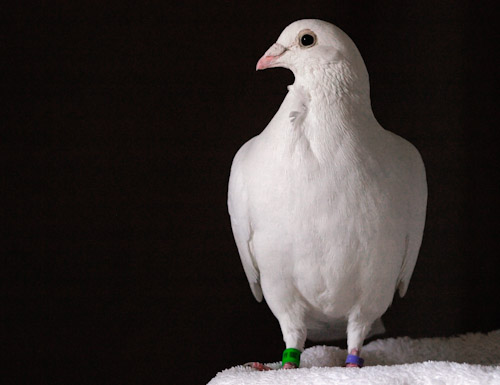
      Homing pigeons can be a variety of colors, but are commonly blue (similar to wild pigeons), or white. These pigeons are raced competitively, used as wedding and event “doves,” or kept as pets. They are muscular and strong flyers with powerful homing instincts, and they are trained to return to their lofts after a race or event. Homers and racers do, however, get lost or injured. Because they are banded, you can often trace their ownership by the information on the band. Occasionally, a lost homing pigeon will assimilate into a wild flock and you may see the occasional banded pigeon foraging with her wild mates.

Blue Bar Racing PigeonWhite Racing Pigeon

RACING PIGEON


A racing pigeon is a pigeon that has been trained to return to its home loft after being released at a distance. The sport of pigeon racing involves releasing pigeons at different distances and timing how long it takes them to return home. The pigeon that returns the fastest wins the race. 
How it works 
  • Training
    Pigeons are trained through repeated practice to return to their home loft.
  • Release
    On race day, pigeons are banded and released together by a starter.
  • Arrival
    When a pigeon returns home, the band is removed from its leg and placed in a timing device.
  • Scoring
    The distance of the flight is divided by the time it took the pigeon to return to calculate its speed.
History 
  • The sport of pigeon racing has been around for thousands of years.
  • Messenger pigeons were used in ancient times to announce the winner of the Ancient Olympics.
  • Genghis Khan also used messenger pigeons.
Races 
  • Races can vary in distance from 100 kilometers to 1,000 kilometers.
  • Races can be won or lost by seconds.

RACING PIGEON


Pigeon racing is the sport of releasing specially trained homing pigeons, which then return to their homes over a carefully measured distance. The time it takes the animal to cover the specified distance is measured and the bird's rate of travel is calculated and compared with all of the other pigeons in the race to determine which animal returned at the highest speed.

Pigeon racing requires a specific breed of pigeon bred for the sport, the Racing Homer. Competing pigeons are specially trained and conditioned for races that vary in distance from approximately 100 kilometres (62 mi) to 1,000 kilometres (620 mi). Despite these lengths, races can be won and lost by seconds, so many different timing and measuring devices have been developed. The traditional timing method involves rubber rings being placed into a specially designed clock, whereas a newer development uses RFID tags to record arrival time.

While there is no definite proof, there are compelling reasons to think the sport of racing pigeons may go back at least as far as 220 AD.[1] It is recorded in the Mishna  that pigeon racers are forbidden from bearing witness. The Sultan of Baghdad set up a pigeon post system in AD 1150, and Genghis Khan used pigeons to carry message to aid his military intelligence.[3] The sport achieved a great deal of popularity in Belgium in the mid-19th century.

Thursday, 16 January 2025

PIGEON CARE


Pigeons have traditionally been fed all-seed diets.
 Commercially available seed mixes for pigeons may contain 2-5 different kinds of seeds. However, the seeds tend to be high-fat and nutrient-deficient and are not the same kinds of seeds that wild pigeons eat. Seeds are also deficient in calcium, vitamin A, and other nutrients. Many times, these seed mixes are fed as the only source of food, leading to ill health and potentially, a shortened lifespan. Seeds can be part of a pigeon’s diet but should not comprise the entire diet.  

DELHI PIGEON LOVERS


Pigeon post 
  • Pigeon post is the use of homing pigeons to carry messages.
  • Pigeons are transported to a destination in cages, where they are attached with messages.
  • The pigeons then fly back to their home, where the recipient can read the message.
  • Pigeons have been used as messengers in many places around the world, including in military situations.


PIGEON TYPES

  Pigeon is a French word taken from the Latin pipio, which means "peeping" chick. Pigeon bird is short-necked and stout-bodied bi...